
The library
Bring the current policy set together.
Group PDFs by publication family, search extracted text, and keep the version you are studying close at hand.
A Graywheel product
Know the policy. Practice the answer.
Turn current policy documents into a working library. Build outlines, flashcards, and practice tests from your PDFs, then return to the source to check your understanding.
Desktop for Windows and Apple silicon Macs. Check your computer →

Start with the policies you need to learn. Keep the original pages available as you read, make study material, and test what you remember.
The library
Group PDFs by publication family, search extracted text, and keep the version you are studying close at hand.
The source
Review source pages, build outlines, and ask questions against the policy material already in your library.
The work
Move into flashcards, multiple-choice tests, readback, and Oral Board practice with the source context still intact.
PolicyVector Reader
Prepare your study material on desktop, then export an encrypted bundle to Reader on iOS or Android.
Bring the outlines, flashcards, tests, and Oral Board scripts you choose. Your full policy library stays on your computer.
Explore Reader →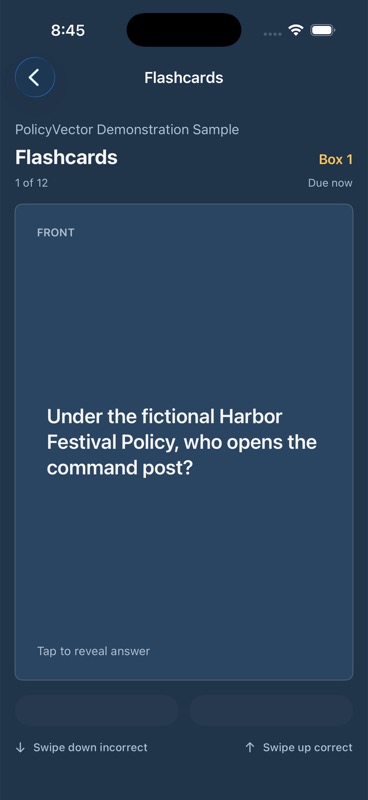
Use a local model for private work. Use a cloud model only when the material is appropriate and you choose to.
Private, on-device
PolicyVector uses Ollama and Qwen3 for supported policy questions and study-material generation. Prompts and source text stay on your machine.
Choose from 4B, 8B, and 14B models to suit your hardware. Larger models need more memory.
See Local AI requirements →Non-confidential text
Use GPT to explain passages, draft questions, or challenge your recall. Only use non-confidential or approved redacted text.
You supply your own OpenAI API key. API usage is billed separately from a ChatGPT subscription.
Clear boundary: PolicyVector does not send your library to OpenAI by default. Cloud assistance begins when you choose it for suitable material; local documents and study artifacts otherwise remain in the workspace.
Documents, extracted text, study material, and progress are stored in your local workspace. You choose what to export or use with a connected service.
Download PolicyVector for Windows or Mac. An individual early access license covers one year and does not renew automatically.